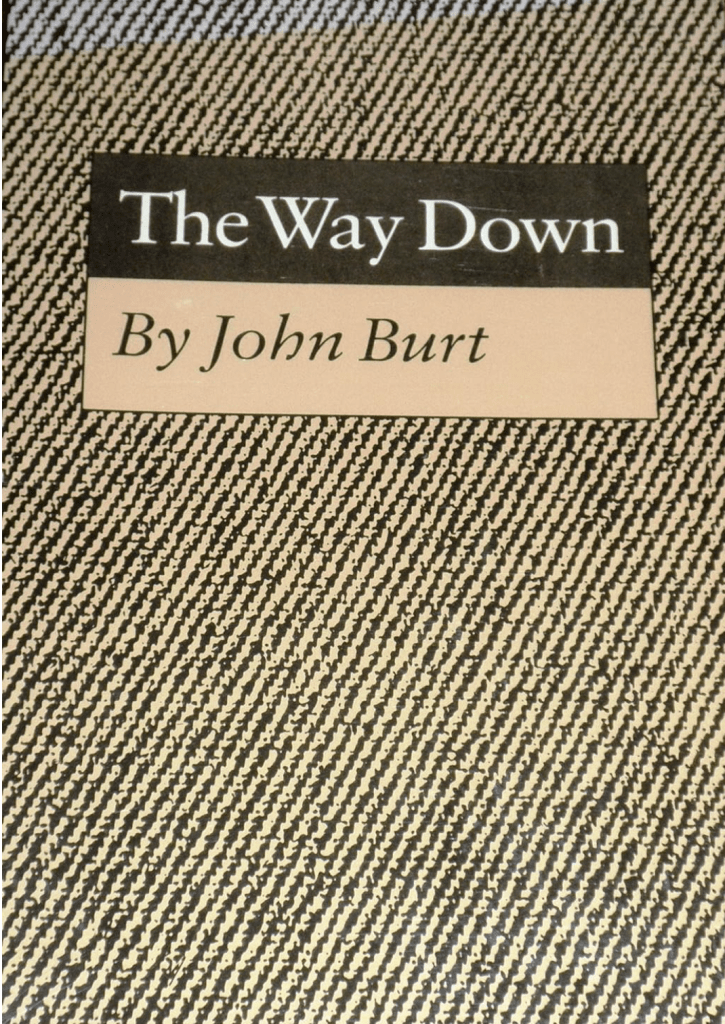
The Way Down (Princeton Series of Contemporary Poets, 69)
ISBN: 978-0691632230
St. Francis and the Wolf

 Saved at last, not at the last of me,
I knelt two-legged, made of guttural air
A little yelp to sound like human prayer.
The saints were cautious, understandably.

I took the cup, and managed not to drool,
But dreamed the wine was blood, as I'd been taught,
And vainly curbed the vain bent of my thought.
 I knew myself an angel, felt a fool.

Could God have erred in making teeth and maw?
Then for his glory I will bite the lamb
Whose terror he transmogrifies to awe
That I may do his service as I am,

Till as I am I leap the mortal gulf
To rage in heaven, a perfected wolf.
About The Way Down
Almost all these poems are narrative, telling stories that turn on some small but crucial shift of sensibility. One hears in them a speaking rather than a singing voice, a voice which, for all its formality and gravity, remains oral and sociable, a voice which tells things rather than spins charms. Their predominant mood is lucid asperity, sometimes breaking out into the angry Calvinism they always barely keep down, sometimes striving to achieve a humane skepticism that always just eludes them.
The book consists of two sections, one concerned with the cruxes and contradictions of private feeling, the other with the unraveling of the public world. Each section centers on a long narrative poem that culminates the building tensions of the poems that precede it and makes possible the resolutions that follow them.
Praise for The Way Down
“For the sake of contraption (like Frost) and of character (like Robinson), John Burt will do a great deal, and his scope and scansion require a great deal, for his theme is nothing less than the reinvention of heroism (King Mark, Mary of Nazareth, St. Francis, Paolo and Francesca, Ariadne) and the invention of a new heroics (Woodrow Wilson, Willard Gibbs). As attentive to ekphrasis as to the sonnet’s narrow room, Burt feels what he knows, and he knows that we can learn from the past only by repeating it. A grand achievement!”
Richard Howard
Review of The Way Down by Fred Chappell
from Chappell, Fred. “Purple Patches, Fuddle, and the Hard Noon Light.” The Georgia Review, vol. 43, no. 2, 1989, pp. 385–94. JSTOR, http://www.jstor.org/stable/41399867
In the reflective lyric, restraint is power. John Burt has discovered a restraint that allows him to write sententiae and invent proverbs without seeming overweening. Of course, the persona poem takes much of the curse off the too-nifty formulation because we attribute the encapsulated wisdom to the speaker rather than to the poet. Burt’s The Way Down contains a large number of persona poems, including “From the Diary of Willard Gibbs,” where we find this couplet:
We love Theory as poets love pale women,
For its perfection and its lack of pity.
Gibbs was not the sort of person to think of mathematics in terms of La Belle Dame Sans Merci, but John Burt’s metaphor here is so exact, so just, that it gives us a lightning insight into the philosopher-scientist’s attitude toward his discipline. Later in the poem there is a description of Gibbs’s investigations into the Second Law of Thermodynamics that comes perhaps a little too close to magazine popularizing (“I learned that every order runs to rot,/ That every motion must in time be spent”), but the wry humanity of the speaker shines in his conclusion: “I have, at least, survived my theories.”
Burt’s most ambitious efforts are “Leonce Pontellier,” which deals with the characters from Kate Chopin’s novel The Awakening, and “Plains of Peace,” a five-part poem with as many speakers, about Woodrow Wilson, his illness, and the First World War. I admire the genuine achievements of both these poems, and, though their complexities are forbidden to a reviewer with limited space, I shall remark that “Leonce Pontellier” requires the preparation of a fresh reading of Chopin and is worth it. “Plains of Peace” needs as background only Burt’s helpful endnote. In this passage, the President’s wife waits for her husband to sing a Schubert song:
This light is from Vermeer, come back to us
To hurt us with its beauty and reproach;
When last we sang these songs we were at peace.
Will we sing again, or will the light
Break and flare at stand-to till night falls?
We will be ghosts, who give ourselves to ghosts ...
Through all these poems there is nothing unnecessary, nothing selftouting, nothing overdone. Burt grasps the central dramas of his situations, sets them in place as firm scaffolding, then builds his poems upon and within them. “King Mark’s Dream” dramatizes the unhappy royal passion for Iseult, who is seen in the poem as a “child he found weeping at his door”; but she is a child whose power “loosened all the knots that held his breath.”
In “Rich Blind Minotaur Led by a Girl,” the girl loves the monster. Burt draws her as someone born wise; she possesses an innocent wisdom ordinary mortals can never attain:
Her innocence was never ignorance.
Love takes us as we are, and at our worst
Loves us the better as our worst is ours.
Burt has many other strengths besides wise utterance. He can make pictures as well as any other poet writing, and he is, as I say, well aware of the advantages that restraint brings to imagery. In “The Funeral Day” the octave of the sonnet exhibits the preternatural silence of a house in which a father or grandfather lies dead. Birdsong annoys the speaker and he rises to close the window-and sees the Connecticut farmland outside with its gauzy white canvases
And there I saw the tobacco-fields
Moving their shrouds in the dusk.
The wind came thoughtlessly over the wide cloth
And lifted the white undersides of leaves.
I didn't close the window. When I sat back down,
I didn't say what I had seen.
ISBN 978-0691632230
 johndaviesburt.com