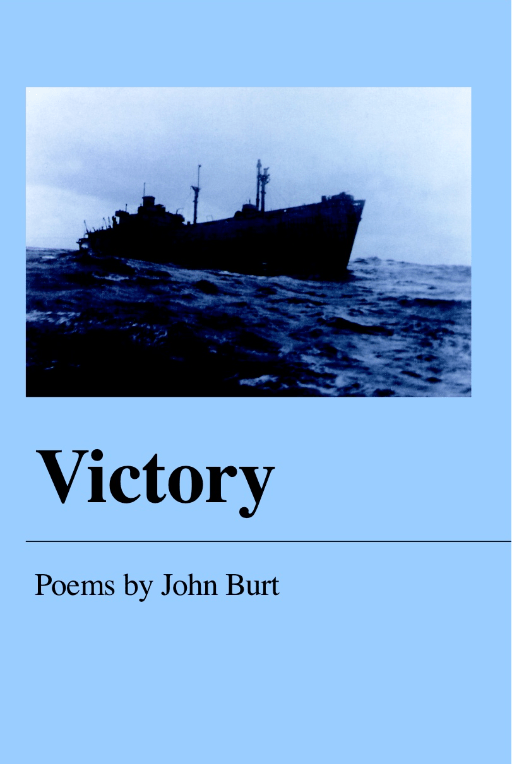
from Victory
Metzger tries to pull ahead again,
Gets overeager, misses twice, falls back;
Has trouble loading up the forward tubes.
O’Leary slips away in a shroud of sleet,
And Metzger follows. He can’t see a thing.
They dance this minuet till almost twelve.
Then suddenly, a hundred yards away
The Thomas turns to face him in the surge
And Metzger barely dodges her. She’s gone.
But no mistaking this time what she’s doing.

“An hour passes with no sign of her
And then a heaving shadow crosses his T.
This time he hits her in the engine room,
A second blast goes up, blows out a hatch.
The Thomas slews off sideways, dead in the water.

“Then Metzger picks up something on his radio:
Three quick little tones: SSS, SSS, SSS,
KLDU, DE, torpedoed, SSS
52, 40, N, 35, W
The tones go out to nowhere, through the storm.
Metzger waits, four hundred yards away,
Hearing the blurry melody of code,
And nothing happens. The Thomas wallows, drifts,
Ships a wall of ocean, shrugs it off,
Reels backwards in the swells, then rights herself.
He sees men scurrying on deck; the smoke
Pours out and bellies down; a hose cocks up,
And plays across the stern part of the bridge.
Then someone standing on the wheelhouse wing
Watching the fire crew struggling with the hose,
Looks off to port, sees Metzger rolling there,
And coolly brings binoculars to his eyes.
Then four bells passes and the smoke subsides.
The fingers still are dancing on the key:
52, 40, N, 35, W
No boats are lowered. SSS, KLDU.
John Burt’s Victory is a suite of narrative poems exploring the nuances of conflict, of wins and losses, and survival. Transcending the merely lyric, these poems have the narrative depth and richness of a novella. In an age of lyrics and autobiography, Victory is unusual in the way it hews to the older traditions of narrative and storytelling.
Praise for Victory
History–`what really happened’–can be challenging material for the poet, but in the expert hands of John Burt it yields consistently fine results. Written in some of the most deftly-crafted blank verse of our time, these narratives focus chiefly on war, and thus on human nature in extremity, on valor and suffering, and on the drama of moral choice as it plays out against a backdrop of potential or actual conflict. Burt’s poems are rooted in the past he knows in such remarkable detail, but their relevance for us now, in an already war-torn new century, is as striking as their high level of artistry.
Robert B. Shaw
John Burt’s Victory is an extraordinary book of four major poems that intricately fuses history and psychology. The fusion is unique, though Burt’s authentic precursors are Robert Browning and Robert Penn Warren. The book begins with a vision of the Maine hero of Gettysburg, Joshua Lawrence Chamberlain, at the close of the Civil War. A dark sequence, almost Faulknerian, follows, in which a Southerner undergoes the guilty self-realization of miscegenation.
Harold Bloom
The title-poem is a grim celebration of the struggle between a heroic Liberty Ship and a U-boat in the stormy Atlantic of January 1944. Strongest of all is the odyssey of the Connecticut poet-diplomat Joel Barlow, who gives us the daemonic horror of Napoleon’s retreat from Russia. Throughout the volume, John Burt manifests a cognitive power and narrative control very rare in contemporary poetry.
In a time of war, John Burt invites us to cast our eyes back into American and European history to consider the relationship between the key words `victory, freedom’ and `death.’ Robert Frost would approve the blank verse of these poems, and Robert Browning would understand the balance of human sympathy and clever artistry needed to animate these half-real, half-imagined people from the past. Full of feeling and the blood of American history, this is a brave heroic poetry.
Langdon Hammer
Victory is a victory: a triumph of story-telling, and of moral and imaginative engagement with history. I couldn’t stop reading: the tales are gripping, and the verse is lean, supple, swift, and so thoroughly voiced and seen that one hardly senses it as verse except in its powerful forward momentum. Burt places us at key moments of conflict and awareness: Joshua Chamberlain’s nightmare reflections after Lee’s surrender (`Ahead lay Washington, half swamp, half shrine’); the diary of a corrupt, pre-Civil War South Carolina politician fearing for his slave children; a grimly riveting account of a battle between a U-boat and a Liberty ship in 1944; and the eerie sequence of letters that track Joel Barlow, the poet from Connecticut, to his improbable death in Napoleon’s retreat from Moscow. Each of the poems turns the idea of victory over and over, asking what it costs, what it proves, what it wins, what stoic dignity survives utmost degradation or trial. Whether he is observing a North Atlantic wave like a wall of steel, or a raven pecking the eyes and nose off the frozen face of a Grenadier, Burt takes us into the heart of action. If Americans think `history will happen somewhere else,’ as Barlow fatuously imagines before he meets his own history, Burt will startle us into thinking again. It’s about time (in every sense)
Rosanna Warren
John Burt’s brilliant tetrad of historically-based narrative poems is unique in the current return of serious poetry to the telling of tales, for the way in which it forms and projects the voices of its speakers, both fictional and, historical (as in the case of the early nineteenth-century poet and diplomat Joel Barlow encountering Napoleon’s retreat from Russia.) These chronicles of matters surrounding the Civil War, merchant ships in WWII and the War of 1812 are commanding not only because of the historical knowledge informing them, but for the poet’s masterful use of his own mode of blank verse to give an original tone, pace and vividness to each of his recountings
John Hollander
Review of Victory by Isaac Cates in the Hopkins Review
John Burt’s new book Victory and Rachel Hadas’s The River of Forgetfulness would surely both appeal to the general, non-academic reader that poets have imagined since before Yeats’s Connemara fisherman, though it seems unlikely that these books will find the wide readership they deserve. Victory delivers something we see rarely in contemporary poetry: sustained narrative poems with a focus on character and ethics, grounded in carefully researched historical reality. Most of Victory consists of three poems in sections, each of which describes or fictionalizes an historical moment on the periphery of war: an American diplomat seeking treaty negotiations with Napoleon before the War of 1812, a South Carolina politician trying to justify or excuse slavery on the eve of the Civil War, and a woman reconstructing the U-boat attack in which her father’s Liberty ship was destroyed. A six-page narrative, “The Passing of the Armies,” opens the collection and sets the terms for what follows: the Union general Joshua Lawrence Chamberlain, returning home with his troops after accepting Lee’s surrender at Appomattox, has a nightmare memory of the Confederate retreat after Gettysburg, then awakes to discover that the night’s camp is built on a three-year-old battlefield still littered with the poorly buried corpses of men from his own regiment. Chamberlain reflects on the dark costs of war, quoting a fragment of Thucydides and a mercilessly cynical piece of Athenian oratory; this theme is never far from the poems in Victory. This introductory poem also speaks of the way history continually returns to inform the present–not only in Chamberlain’s classical analogies and the memory brought up by his dream, but also in the literal resurfacing of the dead soldiers at his unfortunate campsite. This uncanny return of the historical seems to shape Burt’s method itself, which gives forgotten historical moments an opportunity to speak to the present.
Burt has always had an archivist’s eye for the memorable minor
historical moment and a novelist’s sensitivity for characterization: from
the dusty portraits of American history, he draws smart, careful, often troubling
portraits of forgotten characters in their defining moments. These
moments are often points of quiet tension or pained recognition, and even
in the midst of the central poem’s U-boat battle, the emphasis is Captain
O’Leary’s recognition of his own doom. Burt is clearly interested not
only in characterization but also in character, as each of his central figures
is tested to reveal his troubles and flaws. Burt juxtaposes the diplomat
Joel Barlow’s jovial vanity with the terrible deprivations of Napoleon’s
Russian campaign; Burt’s South Carolina politician David Harper damns
himself in his desperate rationalizations of his marriage for money, his
infidelities, secession, and the institution of slavery. Harper is clearly a
villain, repellent on several levels, and Burt makes him fascinating in his
selfishness (and self-deception) without excusing his villainy with any
extenuating circumstances. Harper becomes a kind of warning against the
capacity of the powerful to justify the terrible means that support their
personal ends.
Burt does all this in blank verse as practiced and fluent as any in contemporary poetry. If his idiomatic Frost shades once or twice toward Wordsworthian sonority, the effect seems designed to suggest the voices of his nineteenth-century characters; more often, Burt’s steady, endstopped pentameters simply have the sound of wisdom. Here is Burt’s David Harper, for example, ruminating:
Ambition is not lullabied with praise.
Its wakeful genius, spurred and stayed with doubt,
Saves it alike from joy and from despair.
It is not hobbled by another's scruple ...
It stifles in the moment of repose.
Or here is Captain O’Leary’s daughter, in “Victory,” looking over pictures of dilapidated, decommissioned Liberty ships:
They wear out just like us, she thought, they leave
In death, like us, no trace but junk and filth.
Better to be sunk than come to that.
The rhetorical force that Burt gains from verse like this is worth the occasional archaism, I think, though for some readers it might be a hard sell. There’s something more than just old-fashioned about Burt’s narrative verse: Victory engages with such serious questions of national character that it seems not only deeply historical but original, in the almost archaeological sense of that word that would mean close to the source.
ISBN 978-1933456607
 johndaviesburt.com