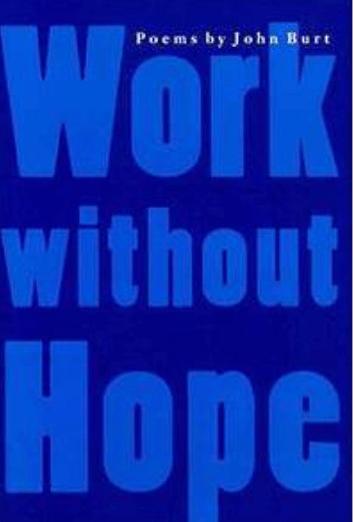
The poems in John Burt’s newest collection aspire to record something of what Wordsworth called “the still sad music of humanity,” that ability to endure the limitations of the world–and the folly of one’s own desires and ambitions in it–until one arrives, beyond disappointment or defeat, at a kind of lucid and reflective acceptance of experience with all of its shades.
The poems are grouped thematically. The first part contains a series of nocturnes about death. The second includes testy confrontations with strangers. The third treats characters faced with moral challenges beyond their capacities. All of these concerns are at play in the long narrative, “Anna Peterson,” a true story, which the author has set at the thematic and emotional center of the book.
“I intend these poems,” Burt writes, “to be chastened by irony but not silenced by it, aware of the complexities of love and aspiration but not soured by them. Most of these poems are narratives in blank verse, and some of them have to do with historical figures. Despite the bleakness of the book’s assumptions about the course of life, I mean always to honor the inner lives of the characters I write about, who mostly face inevitable things with courage and even spirit. The difficulties the characters face are for the most part unresolvable, but they bring to those difficulties a clarity which is almost if not quite redemptive, a clarity I hope is present in the formal and stylistic poise of even the darkest sections of the book.”
Love and Fame
She’d smiled as if she knew him. That kept him up
And scared him some, but more, excited him.
And in the dark, while his brother coughed next door,
He lay awake, wondering about that girl,
Who’d caught his eye just as she tossed her head
To laugh her shy delicious laugh -- at what
He never learned—then handed him that smile
And vanished in the intermission crowd
While he just stood there thinking what to say.
That’s what it’s like. That’s what it must be like.
(He hadn’t seen it happening to him.)
They look back at you. That changed it all.
But would he ever see that girl again?
His brother coughed and choked. He lit the lamp
And brought a glass of port to still the spasm.
 “Just stay a bit, John, won’t you?”
                                                               “Yes, of course.
I’m wakeful anyway.”
                                       “Still, I’m sorry.”
He wiped the sweaty forehead with the sheet.
“Shh. Go back to sleep. I’ll sit awhile.”
Would he have the chance to love that girl,
Or any of the girls (or are there any?)
Who might look back at him in just that way?
It was her gift, a secret, like a poem
She might, just from the blue, have handed him
Clear and whole and wholly eloquent
And never to be written, like the rest.
At the window he could count them: one,
Then two, then three drops falling in the dark,
And to the dark, stars swept from the sky
Flashing downward silently all night.
Give me this hour, God, if nothing else.
Praise for Work without Hope
This memorable volume of poems, the author’s second, offers generous helpings of both tradition and individual talent. Moving through its dramatic monologues and dialogues, its rhymed and unrhymed sonnets, its blank verse narratives, its treatments of history and Americana, and its evocations of northern landscapes, readers will appreciate Burt’s deft weaving of many threads in Anglo-American poetic tradition, especially the legacies of four Roberts: Browning, Frost, Lowell, and Penn Warren. Meanwhile, Burt’s considerable individual talent transforms craftsmanship into metaphor, as he demonstrates the many ways in which his own work, with its stoic refusal to slide into easy resolutions or glib consolations, finds a sustaining courage in the rigors of imaginative labor. Johns Hopkins
Virginia Quarterly Review
John Burt gets credit here for the most cryptic book title. Work without Hope is, of course, not as bad as all that. I was not familiar with Burt’s work before reading for this chronicle, but I’ll look forward to his new verse for its various technical gifts and intelligent, severe vision.
Robert McDowell in The Hudson Review
Many of the poems are narratives in blank verse, including the twenty-page centerpiece, “Anna Peterson.” Constructed as monologues, dialogues, and epistolary addresses, these poems reflect a consistent effort to step outside oneself and enter the lives of others. The best of this group includes the spooky “Aboard the Californian,” which takes place on the rescue ship that was late arriving at the scene of the Titanic’s disaster, the companion pieces “Thomas Chaplin” and ‘‘Jim Slocum” (in the latter, a young couple unwittingly suffocate from exhaust fumes while they are parked for love), and the title poem, in which a drunken handyman comes to the door to rake leaves.
ISBN 978-0801853715
 johndaviesburt.com